Why You’re Hiring Wrong in FinTech
02 April, 2026


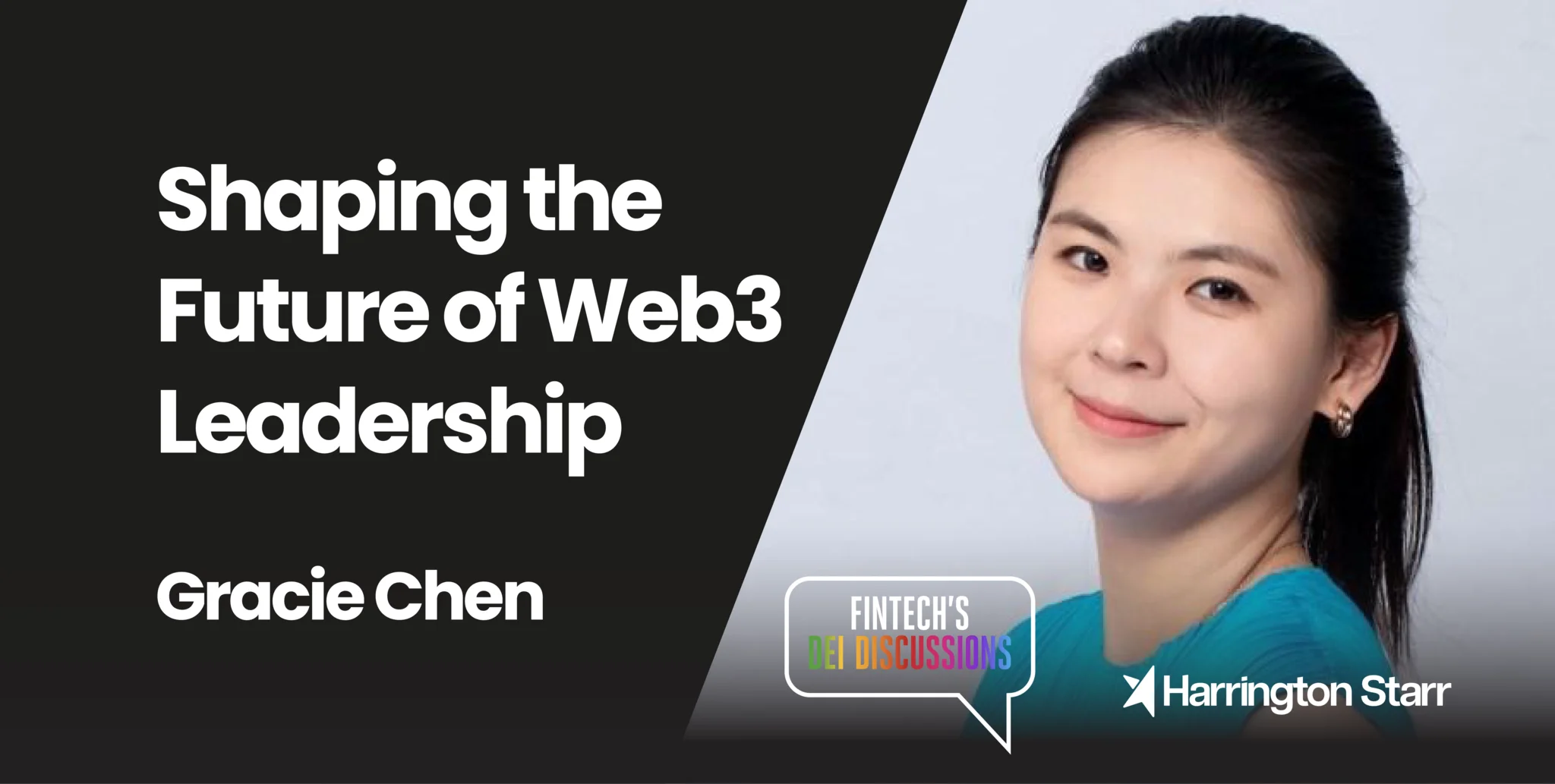
In this episode of FinTech’s DEI Discussions, hosted by Nadia, we are joined by Gracy Chen, CEO at Bitget, for a conversation that spans crypto innovation, inclusive leadership, and what it truly takes to shape the future of Web3. For those working in financial technology, capital markets, and digital assets, this discussion is more than a leadership story. It is a lens into how culture, governance, and hiring decisions influence the infrastructure of the next financial era.
At Harrington Starr, as a global FinTech recruitment business, we regularly speak to leaders navigating transformation across trading, digital assets, blockchain, AI, and regulation. Gracy’s journey provides insight into the type of leadership the industry increasingly needs: resilient, commercially sharp, technologically fluent, and committed to inclusion.
Gracy’s story begins in 2015, when she was working as a TV host and first heard about Bitcoin from colleagues within her network. At the time, Bitcoin was trading at around 300 USD. Curious, she read the Bitcoin white paper and was instantly drawn to what she described as its mathematical beauty. Having studied applied mathematics at the National University of Singapore, she was captivated by the clarity and simplicity of the decentralised ledger concept outlined in just 13 pages.
That early curiosity led her to explore not only Bitcoin, but also Ethereum and XRP. These were the first cryptocurrencies she purchased. She also invested in companies in the space, including Beekip, later rebranded to BitKeep Wallet.
In 2022, Bitget reached out to her. They were looking for someone with a marketing background and a strong interest in cryptocurrency and Web3. Rather than suggesting someone else, Gracy volunteered herself. With around ten years of experience in marketing in the Web2 world, she joined Bitget in 2022. By 2024, she was promoted to CEO. 2025 marked her first full year in the role.
For professionals considering FinTech careers in crypto, Gracy’s path reinforces something we often see in FinTech recruitment: career journeys are rarely linear. Passion, technical fluency, and commercial experience often intersect in unexpected ways.
As CEO, Gracy is focused on growth and innovation. She describes Bitget as still young compared with other exchanges, but with significant potential. One of the most important concepts she introduced in 2025 is UEX, which stands for Universal Exchange.
Traditionally, users navigate between CEX platforms such as Binance or Coinbase, decentralised wallets, stock trading apps like Robinhood or eToro, and AI tools to research tokens or products. Gracy and her team identified friction in this fragmentation. Their response was to build a unified experience.
UEX is designed to combine centralised exchange services, decentralised access, advanced security, AI functionality, and broad asset coverage into one platform. Instead of switching between multiple applications, users can access a universal product offering within one ecosystem.
This concept goes beyond crypto alone. In 2025, Bitget expanded into gold, silver, forex, CFDs, and other commodities, opening its TradFi services to crypto users. Within just a few days of launch, trading volume cleared 20 billion, and more than 80,000 users tried the TradFi assets.
Looking ahead to 2026, Gracy identifies AI and compliance as two core pillars of growth. She emphasises the need for greater regulation and compliance to reach mainstream audiences. For those of us working in FinTech recruitment across digital assets, trading technology, and regulatory technology, this aligns closely with what we are seeing in hiring demand. Firms are seeking leaders who understand blockchain technology, AI, and the compliance frameworks required to scale responsibly.
While innovation is central to this episode, inclusion is at its heart. Gracy’s passion for gender equity began during her Web2 career in 2018, when she was raising funds for a metaverse company she founded. During that process, a male investor told her that although he liked her and her project, he did not invest in female entrepreneurs who were married but did not yet have children. That was her situation at the time.
She describes the comment as a slap in the face. She did not secure that investment, but she proved her leadership capability through her company’s performance and later through her work at Bitget.
When she joined Bitget, she saw an opportunity to drive change. Before becoming CEO, she initiated Blockchain for Her, a programme focused on women’s empowerment in the blockchain space. To date, the initiative has provided more than 100,000 in funding, honoured nine women with awards, hosted more than ten global meetups for over a thousand participants, and in 2025 partnered with UNICEF to elevate its global impact.
Her ambition is clear. She wants women to see themselves not just as participants in Web3, but as leaders shaping the future. She wants young girls to understand how blockchain can be a tool for financial freedom. The slogan she chose for Blockchain for Her encapsulates her philosophy: not ladies first, but ladies forward.
Gracy believes gender inclusion is fundamental to Web3. In her view, decentralisation should mean non-discrimination. At Bitget, more than half of the management team are women. The company focuses on results. As she states, women are just as capable as men.
She also highlights the importance of fluency in blockchain and AI for future leaders. The goal is to build products not just for today’s users, but for future users. This is particularly relevant for firms seeking senior talent in digital assets, AI engineering, product leadership, and regulatory strategy. Inclusive hiring practices combined with technical excellence are not mutually exclusive; they reinforce each other.
Within FinTech recruitment, we increasingly see clients recognising that diversity of thought improves resilience and innovation. Gracy’s perspective reinforces this commercial reality.
When asked what Web3 might look like if more women shaped its culture and governance, Gracy focuses on trust and inclusion. For a technology that aims to serve millions, potentially billions, trust is non-negotiable. Inclusion is equally non-negotiable.
She argues that bringing more women into leadership roles directly influences who gets funded, who gets heard, and whose ideas become part of the global financial infrastructure. More inclusive leadership could surface builders and ideas that might otherwise be overlooked.
She also speaks about resilience. Many women, she notes, are mothers. The experience of bearing and delivering a child builds resilience at the highest level. While she is careful not to stereotype, she suggests that women often approach problem-solving with resilience and alternative thinking. This can help identify blind spots in existing models and strengthen organisations during challenging periods.
For businesses hiring across Web3, crypto trading, blockchain engineering, and digital asset operations, these insights matter. Culture shapes performance. Governance shapes innovation. Leadership diversity shapes strategic outcomes.
In the closing part of the episode, Gracy offers practical advice. She encourages individuals not to be carried away by stereotypes or bias. Everyone, whether a senior executive or a new joiner, can drive positive change.
She challenges the perception that men are measured by potential while women are measured only by performance. In her view, women have immense potential, and everyone should be judged by results rather than gender.
For professionals building FinTech careers, this is a reminder that inclusion is not abstract. It plays out in hiring decisions, promotion criteria, funding conversations, and leadership opportunities. For hiring managers and executives, it is a call to review how potential and performance are assessed.
At Harrington Starr, our work in FinTech recruitment across London, New York, and Belfast places us at the intersection of talent, innovation, and culture. Conversations like this are essential because talent strategy and inclusion strategy are inseparable.
As digital assets mature, as AI becomes embedded into trading and compliance systems, and as regulation evolves, firms need leaders who combine technical depth with cultural awareness. They need executives who understand decentralisation, AI implementation, regulatory expectations, and inclusive governance.
Gracy Chen’s journey from reading the Bitcoin white paper to leading a global exchange reflects the pace of change in financial technology. Her work with Blockchain for Her demonstrates that leadership in Web3 must extend beyond product innovation to ecosystem responsibility.
This episode of FinTech’s DEI Discussions is a reminder that building the future of financial infrastructure requires more than code. It requires trust. It requires compliance. It requires AI literacy. And it requires inclusive leadership.