The Most Talented Person Might Be the Quietest
09 Nov, 2026


Working on smart order routing for a major sell-side bank back in 2007 seems a world away fr...

Working on smart order routing for a major sell-side bank back in 2007 seems a world away from today's Gen-AI solutions and the question of how humans and AI work together. Nearly 20 years ago, we were breaking new ground: that project had a lot to consider, not just technically but from a regulatory standpoint too. How could we make sure the SOR didn't go rogue? Fast forward to today, and on a modern equities desk an order arrives, is sliced across a dozen venues, routed to wherever it'll get best execution, and confirmed. All within milliseconds and nobody touching it. I can’t imagine anyone calling this "AI". It’s worth remembering that every time a conversation about AI in financial services feels like it's happening for the first time, it isn't.
Settlement windows have compressed throughout my career. As head of post-trade at Euronext in 2014, I responded to the changes when the EU moved from T+3 to T+2. T+5 was standard back in 2001. It was manual, paper-heavy, and fraught with human error. Then T+3. Then T+2, where most markets sit today. Now the industry is weighing T+1, and T0 is already a reality in some crypto trading. Each step has taught the same blunt lesson: shorter windows mean lower risk. Fewer days for a trade to sit unconfirmed is fewer days for something to go wrong. And it isn't only settlement. Algorithmic execution, quant models validated on years of historical data, robo-advice serving retail portfolios at a scale no back office could match; none of it happened because the industry got starry-eyed about technology. It happened because there was real ROI in automation. Done properly, it makes markets better: more liquidity, sharper competition, room for new entrants to bring genuine innovation rather than just more headcount. That case was won long before anyone said the words "generative AI."
So what's actually new? It's worth being precise about vocabulary, because "AI" is working hard for two different things. The automation behind settlement compression and algo execution is, broadly, quantitative computation and, in some cases, machine learning: deterministic processing applied to enormous amounts of historical data, finding patterns, back-tested against years of markets, producing bounded, explainable outputs. Agentic Gen-AI is a different animal. It doesn't just spot a pattern; it plans, chains together steps, and takes actions with far less prescribed structure than a traditional model. That difference matters enormously in practice, and it's why "human in the loop" needs a more careful answer than it used to. The real questions aren't binary: how thoroughly has the agent framework been tested, and against what? How much autonomy is switched on for this task? At which step does a human need to say yes before the next one happens? Human-in-the-loop isn't a switch you flip once: it's a calibrated risk dial you set deliberately, task by task.
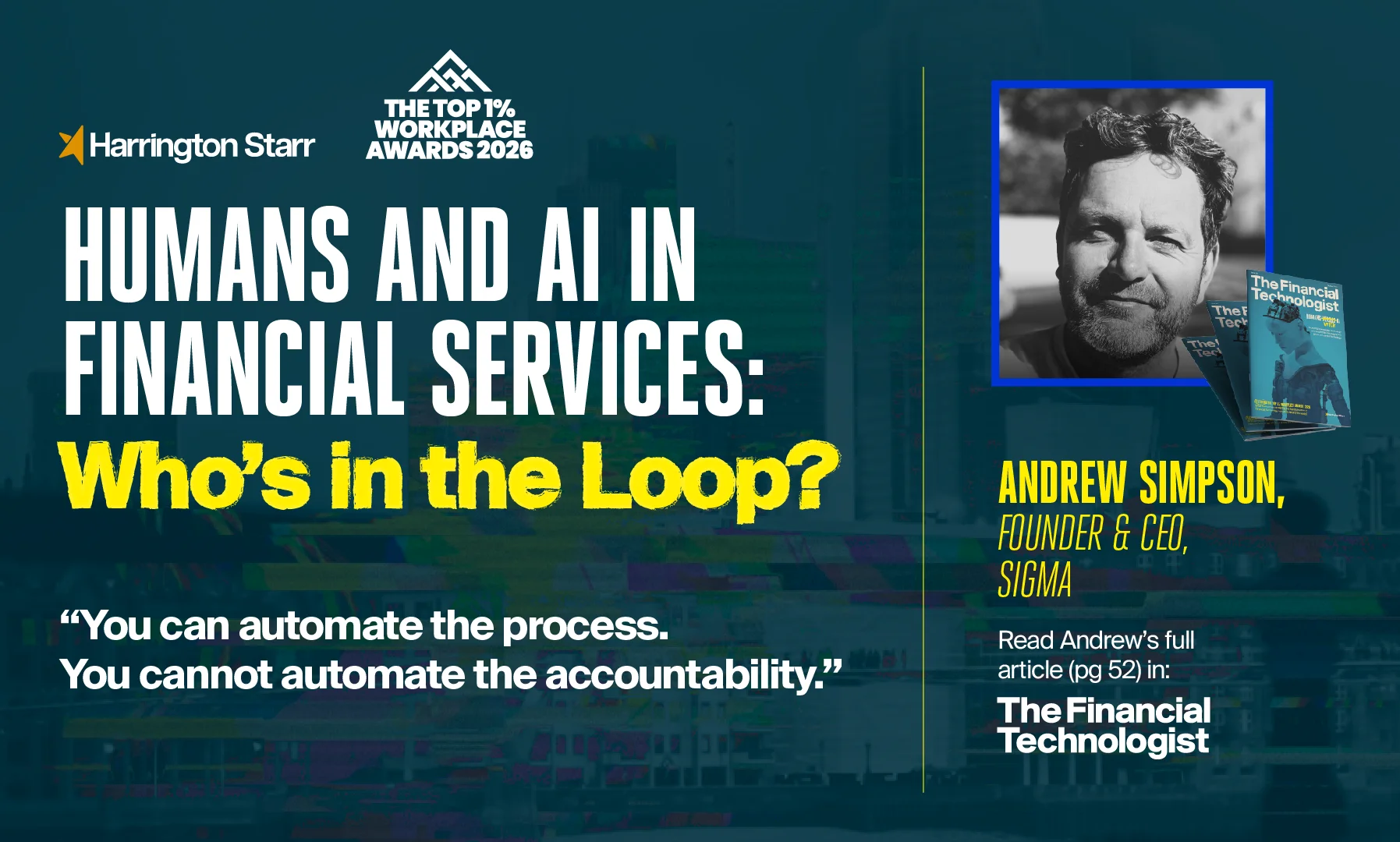
None of this changes a harder truth. Financial services is heavily regulated for good reason, and a regulator will not accept "the model did it" as an answer. You can automate the process. You cannot automate the accountability. Whoever approved that level of autonomy, and the firm that deployed it, own the outcome, regardless of how the decision was produced. That test gets sharper, not softer, with agentic systems, precisely because it's harder to explain why an agent chose to do what it did. The less legible the process, the more the "we didn't outsource our judgment" question needs a real answer, not a shrug.
Which brings me to the question people actually want to ask: is there something a bit too cosy about the relationship between humans and AI creeping into financial services? I don't think so, or at least not in the way the question implies. The real shift isn't AI replacing judgment. It's AI absorbing the grind: reconciliations, drafting research, reducing false positives in surveillance, data formatting that took an analyst a week. Remove that and what's left is more time for the parts of the job that actually need a human, such as client relationships, strategic calls, and the edge cases no model has seen before. That's not a cosy arrangement. That's liberation, and it's the best argument for AI in this industry, not the most alarming one.
You can see where this is heading if you look at where the gaps are still. Straight-through processing clears the clean trades intraday now, but breaks and exceptions still land on someone's desk for manual review, because that's where judgment is required. That's exactly where agentic AI is heading next: chasing down the break, proposing a fix, escalating only when it genuinely should. The same logic applies on the trading desk, where routing is automated but the judgment calls around it (such as when to intervene if a venue's behaving oddly) are where the next wave is aimed. Adapting means building fluency in reading and auditing what an agent did, not just consuming its output, and treating governance and testing rigour as a core professional skill rather than a compliance afterthought.
Both scenes at the start of this piece now operate more quietly and faster than they did in 2001. Neither one is short of people, but those people involved now make far more valuable contributions.'
----------------------------------------------------------------------------
As AI advances across capital markets, the challenge for financial institutions is not simply automating more processes, but knowing where human judgement remains essential. From algorithmic execution to post-trade operations, businesses need professionals who understand trading infrastructure, operational risk and the regulatory responsibilities associated with increasingly autonomous systems. This makes specialist expertise in Trading Technology and Risk & Compliance particularly valuable as firms adopt agentic AI.
At Harrington Starr, we recognise that automation is changing the skills required across Financial Services. Employers need people who can work confidently with intelligent systems, investigate exceptions, challenge automated decisions and maintain accountability. The firms that benefit most from AI will be those that combine technological capability with experienced professionals who know when to trust automation and when to intervene.
Lorem ipsum dolor sit amet, consectetur adipiscing elit. Etiam sit amet est id augue molestie pharetra suscipit et enim. Donec maximus hendrerit augue, eu posuere eros venenatis eu.