When Everyone Has AI, Where Does the Edge Come From?
22 Oct, 2026
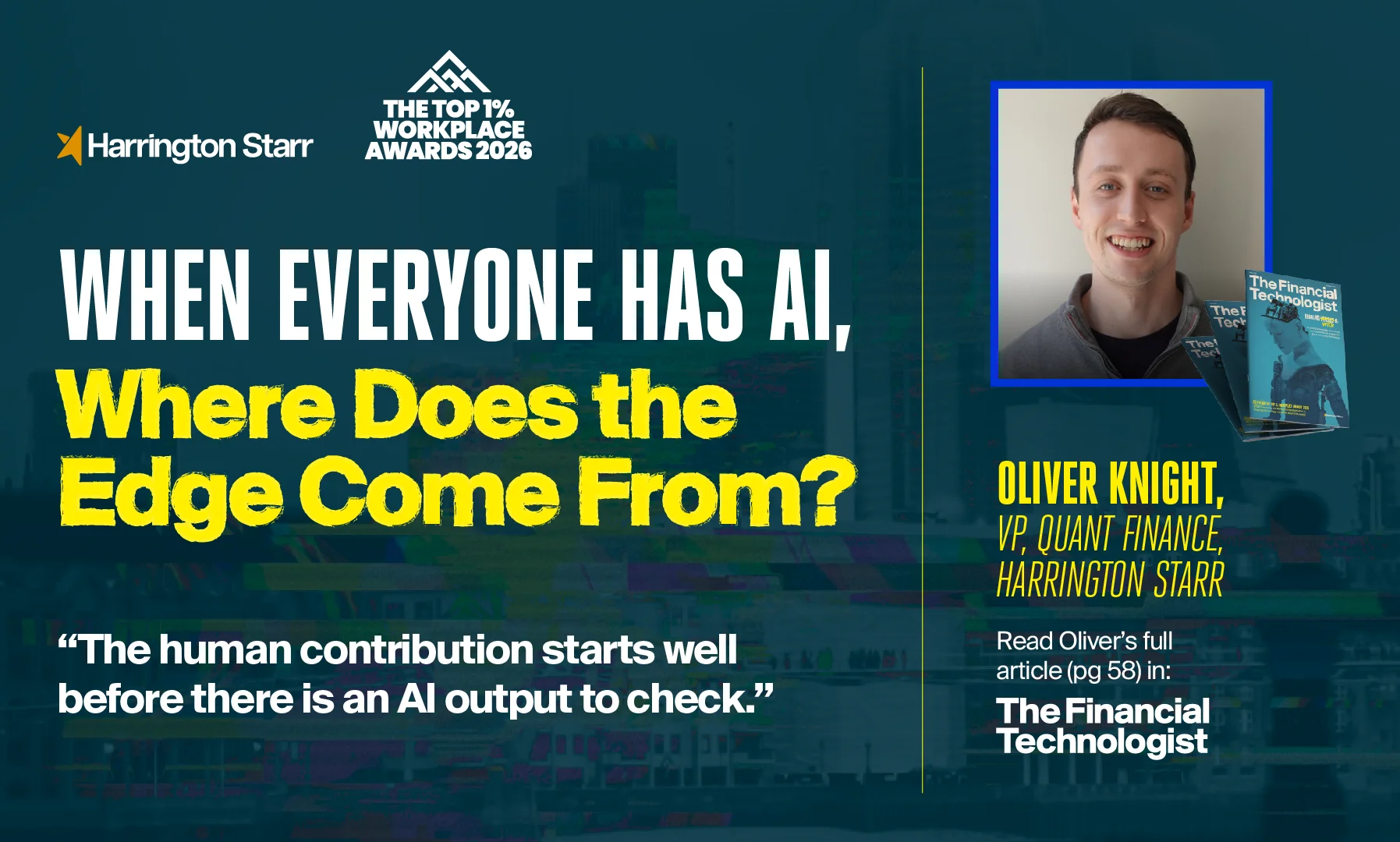

Having spent three decades working in large global banks and leading technology transformati...

Having spent three decades working in large global banks and leading technology transformations, I have seen how systems introduced to solve individual problems can, over time, create complexity across the institution. Systems multiply, data is duplicated, processes cross several teams, and changes that should be straightforward become slow and expensive.
Banks have spent years trying to simplify these technology estates. AI should help them remove complexity. But there is also a risk that banks recreate the same fragmentation in a new and potentially more consequential form.
The next legacy problem may be a collection of AI agents.
An AI agent in financial services is more than a conversational assistant. It is software given an objective, access to information and tools, and permission to complete a sequence of tasks. An agent might retrieve customer records, examine documents, apply policies, compare evidence, prepare a risk assessment or initiate an authorised action. Several specialised agents may work together within one process.
This is already becoming real.
In August, DBS announced that an agentic AI solution had been rolled out to approximately 1,500 relationship managers and credit risk managers. Specialised agents perform more than 70 tasks involved in preparing the first draft of a corporate credit memorandum. Employees then refine the assessment using their knowledge of the client, the industry and the wider risk context.
This is a significant application of agentic AI within an important banking process. It also illustrates why the governance question is changing. When one model supports one employee, the focus is naturally on whether its output is accurate and explainable. When multiple agents gather evidence, interpret information and contribute to a decision, understanding each component separately is no longer enough.
The institution must understand how the complete process works.
Consider a customer moving through a bank. An onboarding agent gathers and validates information. A customer-risk agent assesses the relationship. A credit agent evaluates an application. A fraud agent monitors subsequent activity, while a financial-crime agent considers whether transactions require investigation. A customer-service agent may be trying to resolve an enquiry at the same time.
Each agent may be performing its task correctly, operating within its permissions and meeting the controls established for that use case. Yet the customer may still experience the bank as inconsistent. One agent may request information that another already holds. One may recommend a product while another restricts the relationship. An action that is reasonable within one workflow may create delay, confusion or risk somewhere else.
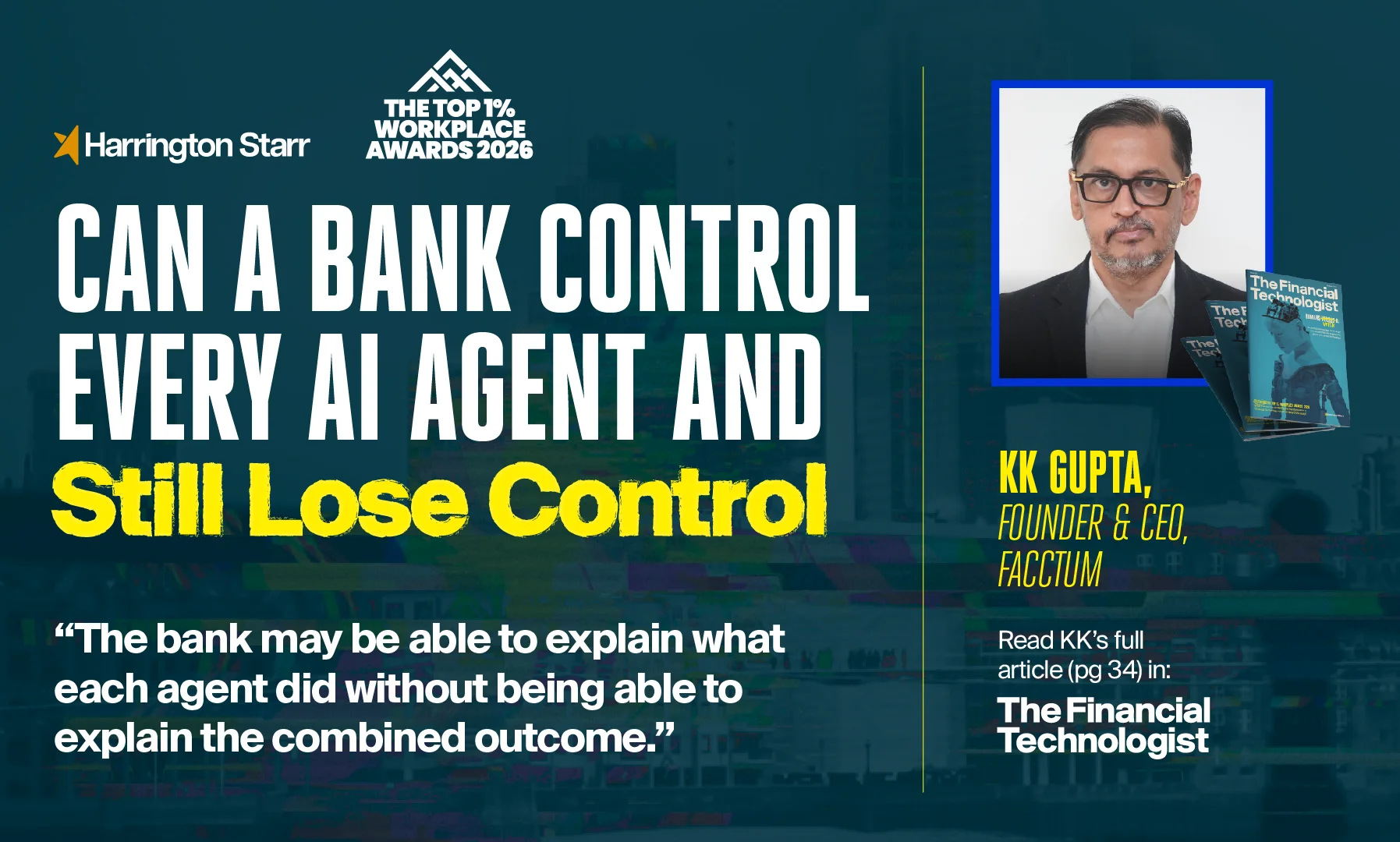
The bank may be able to explain what each agent did without being able to explain the combined outcome.
Recent technology developments show how quickly this environment could expand. Google Cloud’s financial-services platform, announced in August, brings together a managed research agent, specialised skills, numerous data connections and an ecosystem of third-party agents. Deutsche Bank helped shape the research capability and plans to use it initially within its Corporate Bank, with the underlying framework capable of supporting further applications.
The significance is not the number of capabilities. It is that banks will increasingly combine agents developed by internal teams, strategic technology partners and specialist providers. These agents may use different models, follow different update cycles and sit under different business owners, while still contributing to decisions about the same customer or transaction.
Governance must become as connected as the agents and decisions it governs.
Industry participants in the Bank of England and FCA’s Artificial Intelligence Consortium have begun to identify this issue. Minutes published in August noted that most AI use cases involve multiple interconnected models and components. Participants emphasised the need to govern and test the complete AI model system, particularly because individual elements can be updated independently. They also identified limited transparency from third-party providers, inconsistent definitions and shared technical dependencies as emerging challenges.
The issue is therefore not only whether each agent is properly controlled. It is whether all of those agents, working across the bank, still produce a consistent, explainable and appropriate outcome.
This does not mean that banks should slow down agent deployment. It means the governance architecture must develop at the same speed.
Testing individual agents will remain necessary, but it will not be sufficient. Institutions will need to map how agents connect, what information they share, which systems they can instruct and where responsibility passes between them. Changes to one agent must be assessed for their effects on connected processes. Testing must examine the complete outcome, including situations in which agents follow their individual objectives but pull the institution in different directions.
The human role also needs to be considered differently.
The answer cannot be to place another human approval at the end of every workflow. As the number and speed of agent interactions increase, that form of oversight could quickly become procedural. A reviewer presented with a final recommendation may not understand the sequence of actions that produced it.
People must remain accountable, but their most important responsibility will increasingly be to define where agents can act, understand how decisions connect, resolve competing objectives and intervene when the combined outcome is inconsistent with the bank’s obligations.
The question will no longer be only, “Did this agent perform its task correctly?”
It will also be, “Did the bank, through all of its agents, reach the right outcome?”
AI should help financial institutions remove complexity, not rebuild it in another form. The opportunity is to create connected governance now, before fragmented agents become another technology problem that banks spend the next decade trying to solve.
Lorem ipsum dolor sit amet, consectetur adipiscing elit. Etiam sit amet est id augue molestie pharetra suscipit et enim. Donec maximus hendrerit augue, eu posuere eros venenatis eu.