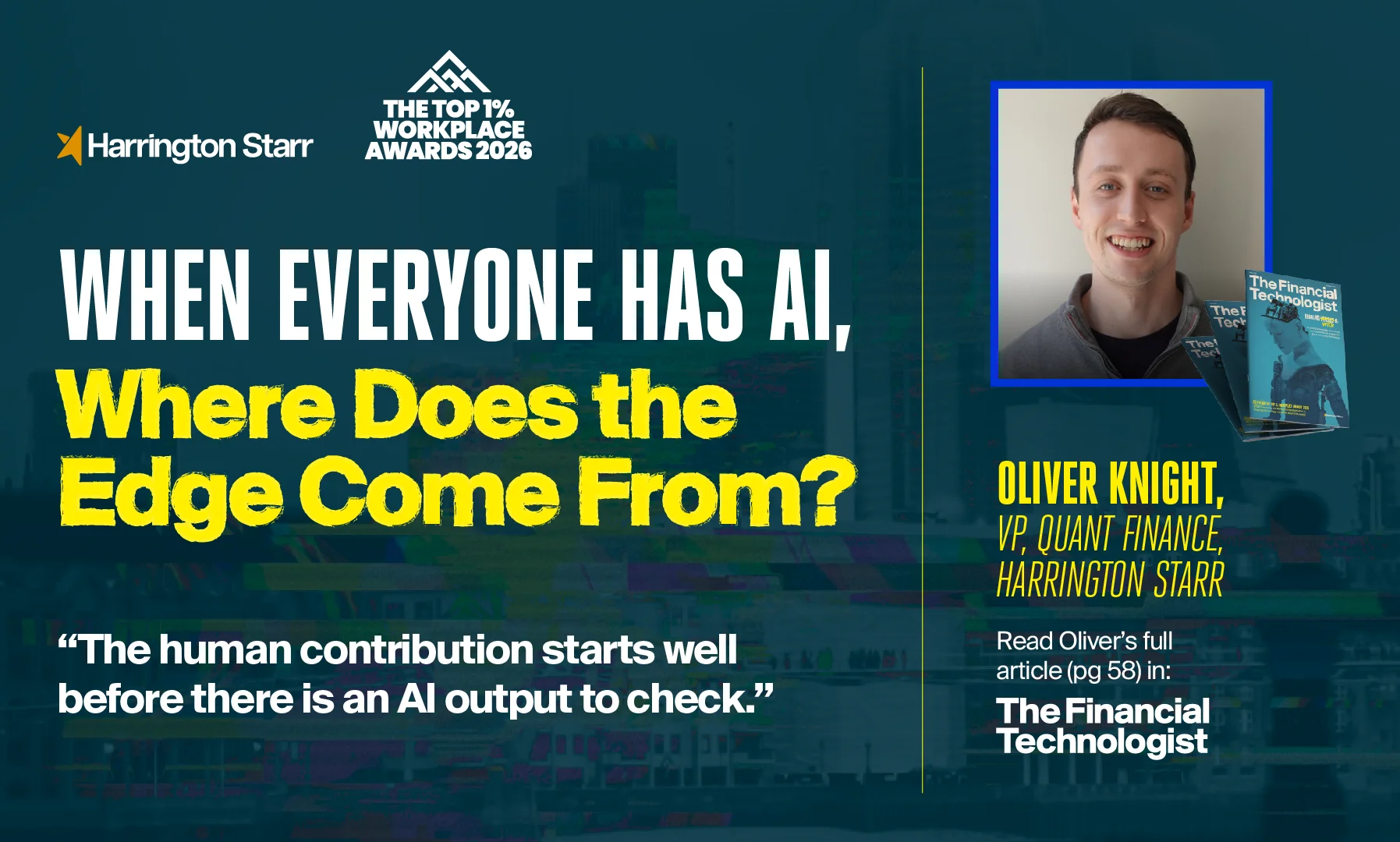
When Everyone Has AI, Where Does the Edge Come From?
22 Oct, 2026

I’m increasingly seeing a pattern in the workplace. Someone needs a report. ...

I’m increasingly seeing a pattern in the workplace.
Someone needs a report. AI drafts 30 pages. The “author” skims them and sends them on. The recipient gets 30 pages, doesn’t have time to read them, and asks AI to summarise them. They skim the summary and send comments back. AI incorporates the comments. The report is declared finished. AI turns it into slides. A human skims those and presents them to another group of humans.
Everyone has been involved. But who actually did any thinking?
There’s nothing particularly unreasonable about any individual decision in that chain. The average adult reads non-fiction at around 238 words per minute. A typical business page might contain 400 to 500 words, meaning that simply reading a 30-page report consumes an hour. That’s before reviewing it, checking the evidence, challenging assumptions or thinking about its implications.
If someone sends you that document 20 minutes before a meeting, of course you’re going to use AI to summarise it.
The darker question is whether the “author” of the document actually bothered to read it either.
When generating another 10 pages costs almost nothing, we’ve removed one of the natural constraints that used to make someone ask: does this really need to be 30 pages?
Generative AI has made cognitive production abundant. It can draft, analyse, summarise, code and create presentations in a fraction of the time it once took us.
That’s useful. I use it every day.
But for a long time, output also served as a rough proxy for effort, capability and sometimes value. Producing a detailed piece of analysis required someone to spend time understanding the subject well enough to produce it.
That proxy has broken.
Research is starting to show an interesting consequence. A study published in Science Advances found that people using generative AI produced stories that were individually rated as more creative and better written, while the stories themselves became more similar to one another.
AI can improve an individual artefact while pushing collective output towards greater homogeneity.
Now consider what happens when AI-generated work is repeatedly processed by other general-purpose AI systems.
AI drafts. AI summarises. AI reviews. AI rewrites.
Excellent human editors compress information all the time. They understand the context and make informed decisions about what matters, what can disappear and what absolutely must survive.
Repeated AI compression without anyone returning to the source or applying informed judgement is something different. Complexity disappears. Minority observations disappear. Uncertainty becomes cleaner. Nuance gets compressed into something plausible, polished and increasingly generic.
Eventually, we are dealing with a representation of a representation of a representation.
There’s another problem with making output almost free: somebody still has to consume it.
Research from BetterUp describes “WorkSlop” as AI-generated work that looks polished but lacks the substance required to meaningfully advance a task, shifting the burden of interpretation or correction onto the recipient. Their research found that, every time workers received a piece of this low-quality AI-generated workplace output, they spent an average of almost two hours dealing with it.
The producer may have saved time. The work didn’t disappear. It moved downstream.
And increasingly, the person downstream has access to exactly the same solution. Faced with more information and less time, they give it to another AI.
This extends beyond internal work. Imagine a team producing a lengthy client deliverable with AI assistance. The client uses AI to digest it and responds based on the summary. The team feeds those comments back into AI. Nobody intended to degrade the work. Everyone made perfectly rational decisions about their own workload.
Yet at every boundary, information can be compressed and reinterpreted.
In financial services, that material might be risk analysis, policy, customer research, compliance interpretation, investment analysis or board papers. The eventual result bearing less and less resemblance to the underlying evidence or original requirement is more than an aesthetic problem. It’s value destruction.
AI output is increasingly cheap. Human attention remains expensive, particularly informed attention from someone with the context and expertise to recognise what matters.
That shifts the value of human contribution towards judgement, context, challenge, domain expertise and accountability.
And this leaves organisations with a different set of questions.
What actually needs to be produced? Who needs to consume it? Where must human judgement be applied? What information must survive compression? Which decisions require someone to return to the source?
And, for an industry competing for talent: if judgement, context, challenge and accountability are increasingly what you’re paying humans for, are you recruiting, developing and rewarding them accordingly?
AI can do more and more of the work.
We need to get much better at designing where the thinking happens. Before the next 30-page report lands in our inbox.

Lorem ipsum dolor sit amet, consectetur adipiscing elit. Etiam sit amet est id augue molestie pharetra suscipit et enim. Donec maximus hendrerit augue, eu posuere eros venenatis eu.