Babb talks to BABB. London & The Future of On Chain Finance
01 April, 2026

Capital markets are not drifting through incremental change. They are accelerating through it.
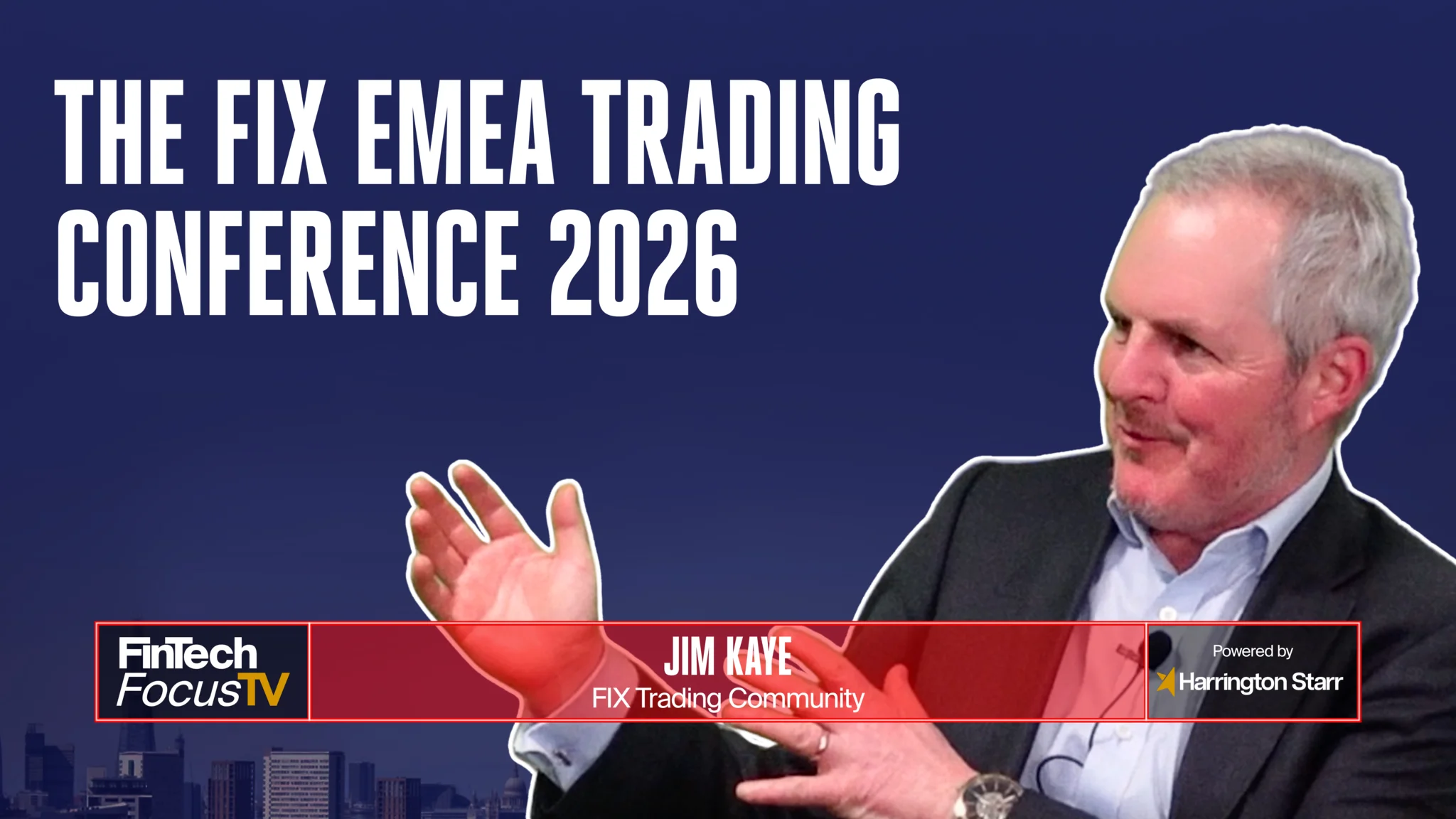
In this episode of FinTech Focus TV, Toby Babb sits down in the studio with Jim Kaye, Executive Director of the FIX Trading Community, to unpack the thinking behind The FIX EMEA Trading Conference 2026 and its central theme: Finance at the Edge of Change.
What quickly becomes clear is that this is not simply a conference preview. It is a reflection of a market structure under genuine pressure, regulatory, technological and human.
As Jim explains, the theme was deliberately chosen to bind the entire day together around a cohesive narrative. Rather than hosting disconnected panels, the FIX Trading Community wanted to acknowledge what practitioners are already feeling: the velocity of change is intensifying.
It is tempting, Jim notes, to describe the current environment as unprecedented. The industry often uses that word. But this time, the drivers are multiplying simultaneously.
There is innovation from within capital markets, new trading workflows, new instruments, new efficiencies, but there is also pressure coming from outside the industry. Regulation continues to expand in complexity across the UK and EU. AI is moving from theoretical to operational. Emerging technologies like quantum computing sit on the horizon.
These are not abstract shifts. They are real operational forces shaping trading desks, market infrastructure and technology teams today.
One of the major pillars of the conference agenda focuses on regulatory developments. For practitioners in trading, market structure, compliance and operations, the detail of regulation matters deeply.
As Jim outlines, there is significant activity coming down the pipeline, particularly across UK and EU jurisdictions. Much of this regulation is highly granular, the kind that drives workflow changes, reporting requirements and technology build projects.
For organisations operating across borders, the complexity compounds.
This regulatory evolution directly affects capital markets hiring patterns, governance structures and technology priorities. It also increases the demand for professionals who can translate policy into execution.
AI has been part of industry dialogue for years. But as discussed in the episode, it is no longer something happening “over there somewhere”.
AI is increasingly embedded in day-to-day operations. From analytics and automation to risk modelling and workflow optimisation, the practical implementation is accelerating.
At the same time, regulators are examining AI deployment carefully. This dual dynamic, adoption and oversight, creates both opportunity and uncertainty.
For capital markets leaders, the question is no longer whether AI matters. It is how quickly it will reshape competitive advantage.
While AI dominates headlines, the episode highlights another important point: it is not the only technological wave forming.
Quantum computing is discussed as a technology that may not yet have a defined financial application, but is unlikely to be irrelevant. History has shown that dismissing emerging technologies as distant can be costly.
Capital markets has traditionally been early to adopt performance-enhancing infrastructure. Whether quantum computing becomes a core trading tool remains to be seen, but ignoring it would be imprudent.
The conference also dedicates attention to fixed income, a market that continues to evolve structurally.
From electronic trading adoption to data normalisation and analytics, fixed income workflows are transforming. Practitioner-level discussion in this space is particularly valuable because change here often unfolds differently from equities.
For professionals in fixed income trading and technology, this conversation remains highly relevant.
Perhaps the most compelling dimension of the episode is the human one.
Jim makes a clear point: someone has to manage all of this change.
Regulatory expansion, AI integration, governance demands and technology evolution all place sustained pressure on individuals. Capital markets has long been a high-performance environment. But sustained structural change compounds that stress.
The conference addresses this directly by bringing in perspectives from outside the industry, including individuals accustomed to high-pressure environments such as polar exploration and military leadership.
The lesson is clear: resilience, adaptability and leadership matter as much as technology.
Another standout element of The FIX EMEA Trading Conference 2025 is the emphasis on the NextGen community.
Rather than positioning emerging professionals as passive observers, the agenda gives them ownership. From speed networking sessions with senior leaders to a formal debate on financial education, the next generation is being given a visible platform.
This is not symbolic inclusion. It reflects a recognition that the industry’s future resilience depends on developing new voices.
Jim is explicit about one ambition: attendees should leave feeling they have experienced something more than a typical conference.
Education, networking and debate are structured into a cohesive experience rather than a sequence of isolated sessions.
For a sector that often repeats familiar talking points, this deliberate framing matters.
From a recruitment and talent perspective, the episode underscores several themes:
For capital markets firms operating in London and across Europe, attracting individuals who can navigate these intersections is critical.
While the episode centres on The FIX EMEA Trading Conference 2026, the underlying conversation extends far beyond a single date in London.
Capital markets infrastructure is evolving. Market participants are balancing innovation with compliance. Technology is accelerating faster than organisational structures can always absorb.
In that environment, forums that bring together practitioners, regulators, technologists and emerging leaders become more than networking opportunities. They become strategic checkpoints.
The message from this episode is not alarmist. It is pragmatic.
Change is accelerating. Pressure is rising. Adaptation is non-negotiable.
And those who understand the velocity of that change, rather than react to it, are likely to maintain an edge.