Why the Buy-Side Is Rebuilding Trading Technology
For much of the past two decades, buy-side trading technology followed a familiar pattern. Large, monolithic order management systems sat at the centre of the investment workflow, designed primarily to support portfolio managers, compliance teams, and post-trade operations. Execution functionality existed, but often as an extension rather than a core capability.
That model is now under sustained pressure.
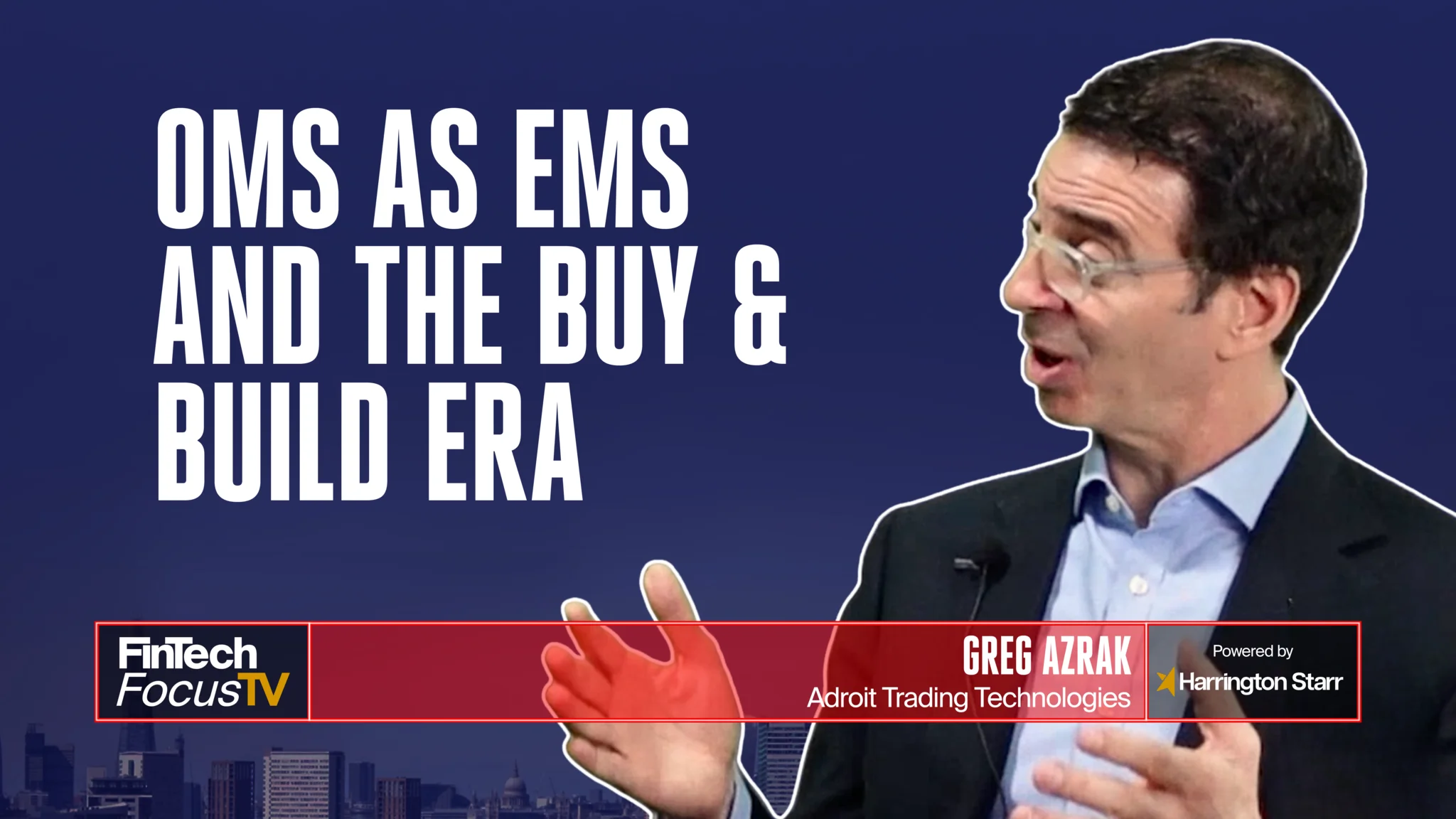
In this episode of FinTech Focus TV, Toby Babb sits down with Greg Azrak, Head of Business Development at Adroit Trading Technologies, to explore how buy-side firms are rethinking execution technology, why OMS platforms are no longer sufficient on their own, and how buy-and-build strategies are reshaping capital markets infrastructure.
The conversation reflects a broader shift taking place across asset managers, hedge funds, and alternative investment firms: trading desks are demanding tools built for how markets actually function today.
OMS Platforms and Their Structural Limits
Traditional OMS platforms were built to solve a very specific problem. They excel at portfolio modelling, compliance checks, order capture, and post-trade workflows. For portfolio managers and operations teams, they remain indispensable.
Where they struggle, however, is at the point of execution.
As Greg explains, OMS platforms were never designed with traders as the primary user. They are optimised for process control rather than market interaction. In listed, highly electronic markets, that limitation can be partially mitigated through integrations with execution management systems. In OTC markets, the gap becomes far more visible.
Fixed income, OTC derivatives, FX forwards, and structured products all operate across fragmented liquidity pools, varied protocols, and a mixture of electronic and voice trading. The execution process is rarely linear, and discretion plays a far larger role than many systems assume.
This structural mismatch has created growing frustration on trading desks, particularly as market complexity has increased.
Why Traders Need Different Tools
A central theme of the episode is that trading technology must reflect the realities of market microstructure.
Fixed income, for example, is not a single asset class. Corporate bonds, municipal bonds, mortgages, CDS, and structured credit all trade differently, often with limited transparency and inconsistent liquidity. Attempting to treat them as a single category through a generic execution layer inevitably leads to compromises.
Greg points out that many so-called fixed income EMS platforms focus narrowly on specific workflows, such as electronic corporate bond trading. While effective in those contexts, they fail to support the broader range of instruments and execution styles required by sophisticated buy-side desks.
Traders operate across voice, click-based, and automated workflows, often within the same day. A system that forces them into a single execution paradigm creates friction rather than efficiency.
The result is a growing demand for EMS platforms that prioritise trader needs, support discretion, and integrate seamlessly with existing OMS infrastructure.
OMS as EMS: A Concept That Never Fully Landed
The idea of OMS platforms evolving into full-featured EMS solutions is not new. Many large vendors have spent years attempting to close that gap.
Yet, as Greg notes, these efforts have often been incremental rather than transformative. Execution capabilities are added, but without fundamentally rethinking how traders interact with markets. The result is functionality that works “well enough” for low-intensity execution, but breaks down under more complex trading conditions.
This is particularly evident in OTC markets, where execution is rarely a single action and often requires negotiation, order shaping, and real-time decision-making.
Rather than replacing EMS platforms, many OMS vendors have effectively reinforced the case for specialist execution tools that can operate alongside them.
The Rise of the Buy-and-Build Era
One of the most important insights from the conversation is the shift from a “buy or build” mindset to a buy-and-build strategy.
Historically, firms faced a binary choice: purchase a vendor platform or invest heavily in internal development. Today, that distinction is increasingly blurred. Buy-side firms are selecting best-in-class platforms for core functionality and then building custom layers on top to address their specific requirements.
This approach recognises a simple reality: no vendor can meet every client’s needs perfectly.
As Greg explains, firms may choose to build proprietary front ends tailored to their workflows while relying on vendor platforms to handle connectivity, normalisation, and execution plumbing. APIs become the foundation that allows these ecosystems to function coherently.
The result is a more modular technology stack, where flexibility and interoperability matter more than all-in-one solutions.
APIs, Automation, and Hybrid Trading Desks
Automation is often discussed as a single destination, but the episode makes clear that trading desks operate along a spectrum.
Some strategies are fully systematic, with algorithms interacting directly with liquidity providers through APIs. Others remain highly discretionary, reliant on trader judgement and voice execution. Most desks sit somewhere in between.
What has changed is the expectation that systems must support all of these modes simultaneously.
Greg highlights the importance of API-first architectures that allow clients to operate “headlessly” when required, while still providing rich user interfaces for monitoring, intervention, and discretionary execution. The goal is not to eliminate screens or human involvement, but to ensure technology adapts to how desks actually function.
This hybrid model is becoming the default for modern trading operations.
Market Investment Cycles and the Return of Technology Spend
The episode also situates these technology shifts within a broader market context.
After a period of caution following the rapid expansion of 2020–2022, many firms delayed major technology investments. Decisions took longer, due diligence increased, and vendors faced extended sales cycles.
According to Greg, that dynamic shifted materially through 2024 and into 2025. Buy-side firms began investing again, driven by the need to improve productivity, reduce friction, and remain competitive in increasingly complex markets.
This renewed investment has not been speculative. Buyers are more rigorous, more focused on outcomes, and far less tolerant of platforms that fail to deliver tangible value.
Cost, Opportunity, and Transaction Efficiency
One of the most practical frameworks discussed in the conversation is how firms evaluate the cost of trading technology.
Greg breaks this into three broad categories.
The first is total cost of ownership. Forcing an OMS platform to operate as an EMS often requires significant internal development, professional services spend, and ongoing maintenance. These costs are frequently underestimated.
The second is opportunity cost. Systems that limit execution flexibility can prevent firms from accessing new instruments, protocols, or trading strategies. Missed opportunities rarely appear on balance sheets, but they have a direct impact on performance.
The third is transaction cost efficiency. Access to multiple venues, dealers, and protocols through a single execution layer allows traders to find better pricing, reduce slippage, and shape orders more intelligently.
Together, these factors explain why firms increasingly view execution technology as a self-funding investment rather than a pure expense.
AI, Automation, and Realistic Expectations
The conversation also touches on the role of AI in trading technology.
While AI and automation are transforming areas such as portfolio management, data analysis, and client service, Greg is clear that their application at the point of execution is more constrained. Trading requires precision, determinism, and full auditability. Approximate outcomes are not acceptable when trades must settle accurately to the smallest unit.
As a result, AI’s near-term impact on trading desks is likely to focus on supporting decision-making rather than replacing it. Automation remains critical, but it must operate within well-defined rules and controls.
This pragmatic view reflects a growing maturity in how the industry approaches emerging technologies.
What Buy-Side Leaders Should Be Thinking About Now
Looking ahead, the episode offers clear guidance for buy-side leaders planning their technology strategies.
Rather than chasing trends or attempting wholesale platform replacements, firms should focus on understanding where their existing systems create friction. Identifying execution bottlenecks, workflow mismatches, and integration gaps provides a far stronger foundation for investment decisions.
Equally important is recognising that trading technology is no longer a static infrastructure choice. It is an evolving capability that must adapt as markets, regulations, and strategies change.
For many firms, that means embracing modular architectures, specialist platforms, and API-driven integration rather than relying on single-vendor solutions.
Trading Technology and Talent in Capital Markets
These shifts in technology architecture also have direct implications for talent.
As buy-side firms adopt more flexible, integrated trading stacks, demand increases for professionals who understand both market structure and technology. Execution specialists, trading technologists, and integration-focused engineers play a critical role in making buy-and-build strategies successful.
For organisations like Harrington Starr, which work closely with capital markets firms on technology hiring, this trend reinforces the need for highly specialised talent across trading systems, execution platforms, and market infrastructure.
The firms that succeed will be those that align technology decisions with the expertise required to operate them effectively.
A Market Still Evolving
If there is one clear takeaway from the episode, it is that buy-side trading technology is still in a period of active evolution.
OMS platforms remain essential, but they are no longer the centre of gravity for execution. EMS platforms, APIs, and modular architectures are reshaping how desks operate, particularly in complex OTC markets.
The buy-and-build era reflects a more realistic understanding of both vendor limitations and internal capabilities. Rather than seeking perfect systems, firms are assembling ecosystems that allow them to trade more effectively, respond more quickly, and adapt as markets change.
As Greg’s experience illustrates, this shift is not theoretical. It is already playing out across buy-side firms globally, and it will continue to define trading technology decisions well into 2026 and beyond.