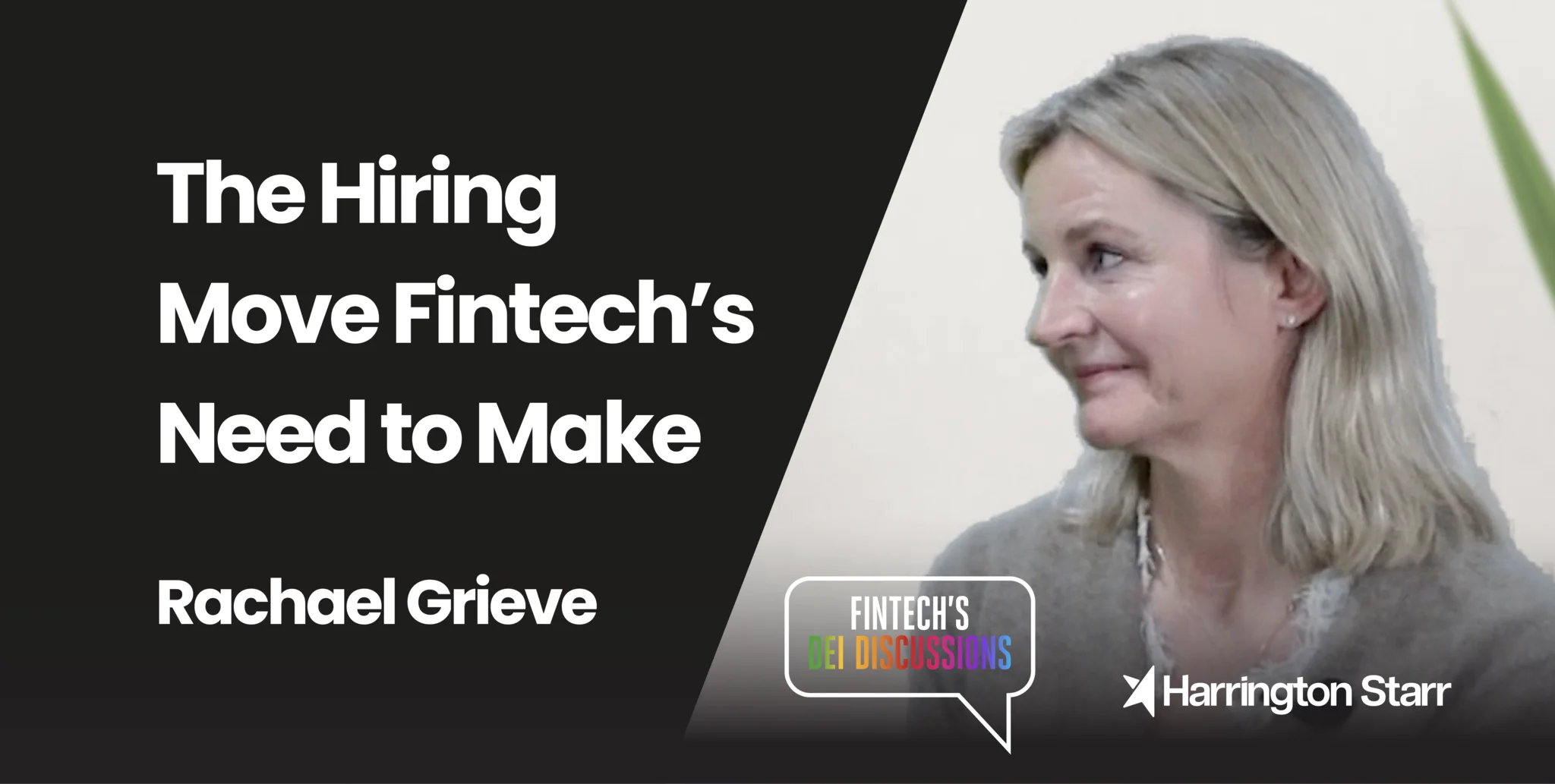
The Hiring Move Fintech’s Need to Make
24 March, 2026

In this special 2026 International Women’s Day episode of FinTech’s DEI Discussions, recorded ahead of Harrington Starr’s flagship IWD event, Leadership That Opens Doors, Nadia Edwards-Dashti, Chief Customer Officer at Harrington Starr, and Georgia Richardson, Global Head of Marketing, sit down with three of our event sponsors to explore what leadership really means in today’s financial technology landscape.
Joining the conversation are Lynda Clarke of Nayax, Claire Court of Delta Financial Systems, and Matt Smith of SteelEye. Together, they unpack why “Leadership That Opens Doors” is such a powerful theme for 2026, why International Women’s Day must involve all genders, and why fair opportunity is not just a moral imperative but a business-critical priority.
For Harrington Starr, a global FinTech recruitment business operating across London, New York and Belfast, this conversation goes to the heart of what we see every day in the market. Talent does not rise in isolation. Careers are shaped by access. Opportunity is influenced by leadership decisions. And inclusive cultures are built intentionally.
This episode is not abstract theory. It is grounded in lived experience across FinTech, RegTech, payments and financial services technology.
Nadia opens the episode by explaining how the theme for Harrington Starr’s International Women’s Day 2026 event came together. Once the phrase “Leadership That Opens Doors” emerged, the alignment was immediate. Each sponsor, in their own way, wanted to discuss how we give back more to the industry and community.
As Nadia reflects, we are navigating a period shaped by geopolitical tension, economic uncertainty, workplace restructuring and redundancies. In such climates, conversations about equality and opportunity can feel either urgent or sidelined. Harrington Starr’s approach, particularly through FinTech’s DEI Discussions and our IWD events, has always been to find a constructive path forward.
In FinTech recruitment, we are witnessing how pressure at the top of organisations often filters down into cautious hiring, tightened budgets and risk-averse decision-making. In these environments, who gets opportunity can narrow. Leadership becomes even more influential.
“Leadership That Opens Doors” invites leaders to reflect on two simple but powerful questions. Who opened doors for you? And who are you opening doors for now?
Georgia expands on this, describing the theme as grounded in reality. Careers do not progress by accident. Opportunities are shaped by everyday decisions. Who is invited into the room. Who is backed for a stretch project. Who is encouraged to test the waters of senior leadership. These moments accumulate.
For clients working with Harrington Starr across Quantitative Finance, Cyber Security, Cloud Engineering, Product Management and Sales & Marketing, we see the same dynamic. Performance alone is not always enough. Visibility, advocacy and access matter.
Lynda Clarke brings a particularly compelling insight to the discussion. She describes the most difficult stage of becoming a leader as “that middle part”, the transition from team leadership into senior leadership.
In financial services and FinTech hiring, this is a familiar inflection point. The jump from mid-management to executive level is where representation often drops, particularly for women. Lynda highlights that progression at this stage is not just about performance. It is about being known, being seen, and being allowed to explore potential.
From a FinTech recruitment perspective, this resonates strongly. We frequently partner with organisations seeking to improve gender diversity at senior levels, yet the pipeline challenge often sits in that middle layer. Talent exists. Capability exists. What is sometimes missing is sponsorship and advocacy.
Lynda frames opening doors as helping people understand how to step through them. It might mean mentoring, coaching, or simply giving someone exposure to senior meetings. It might mean allowing someone to “test the waters” rather than waiting for them to prove themselves beyond doubt.
This is particularly important in industries like financial technology, where innovation depends on fresh thinking. If we only promote those who fit historical leadership moulds, we narrow the future of the sector.
Claire Court shares that she has been fortunate in her own career, with opportunities to grow and develop. However, she recognises that this is not universal. Her belief in paying forward opportunities is clear. Leadership that opens doors can take many forms. It could be a shift in career direction. A spotlight moment. An invitation to contribute beyond someone’s comfort zone.
At Delta Financial Systems, Claire describes a culture that celebrates diversity across gender, background, belief and ways of thinking. Crucially, she highlights platforms that enable participation, from client projects to technology spikes, and a recognition that stepping outside comfort zones requires support.
For FinTech employers, this speaks directly to culture as a competitive advantage. In a highly competitive hiring market across Data Engineering, Quant Research, DevOps and RegTech, culture influences retention as much as salary does. Inclusive environments drive engagement, innovation and long-term performance.
Lynda reinforces this by connecting fairness directly to business outcomes. Equality and diverse perspectives are not simply ethical aspirations; they are commercially advantageous. Diverse thought leadership leads to better innovation and better decisions.
As a FinTech recruitment business, Harrington Starr consistently advises clients that inclusive hiring strategies are not about optics. They are about resilience and growth. Organisations that embrace diverse viewpoints are better positioned to navigate market volatility.
A central theme of this episode is that International Women’s Day is not exclusive. Claire emphasises that everyone deserves the opportunity to progress, and sometimes that requires someone else to open a door.
Matt Smith adds that when people think of International Women’s Day, they often think solely of women in the workforce. However, diversification across gender, demographics, religion and nationality is fundamental to building a modern society and workforce. As a father of two daughters, he speaks about the responsibility to support women entering the workforce.
Lynda addresses a common question, why is there not an equivalent “Men’s Day” with the same profile? She acknowledges that International Women’s Day has evolved. It is now about equality for everybody. However, she also notes that equality has not yet been fully achieved, and additional support remains necessary.
This inclusive framing is important for FinTech leadership teams. True workplace equality requires structural support for both men and women, including policies that recognise caregiving responsibilities. Lynda’s example of balancing work and family responsibilities with her husband illustrates what practical equality looks like.
In financial services recruitment, we increasingly see candidates, across genders, asking about flexible working, parental leave and inclusive policies. These are no longer peripheral issues. They are central to talent attraction and retention.
When the discussion turns to fair opportunity, the sponsors are unequivocal. Lynda notes that even children understand fairness. Beyond that moral baseline, she highlights the commercial value of diversity. Different perspectives improve innovation and decision-making.
Matt reflects that without diversification, organisations miss opportunities. Teams can easily default to working with those who feel familiar. Opening doors broadens potential.
Claire reinforces that the best teams are those with diversity of backgrounds, thought processes and skills. She speaks about actively removing quiet bias and avoiding assumptions about what someone can contribute.
In FinTech hiring, quiet bias can manifest subtly. It might influence which CVs are shortlisted, which career breaks are scrutinised or which technical profiles are considered “cultural fits.” As a specialist FinTech recruitment partner, Harrington Starr works closely with clients to mitigate bias in hiring processes and to build more inclusive talent pipelines.
Equality is not passive. It requires systems and awareness.
One of the most powerful sections of the episode centres on the idea that leadership is not a position; it is a mentality. Lynda articulates that you can be a manager and not a leader, and you can be a leader without being a people manager.
Opening doors can mean mentoring someone for three months. Helping them navigate imposter syndrome. Inviting them to observe a management meeting. Encouraging them to speak up.
Lynda speaks candidly about self-doubt as a barrier. Confidence and imposter syndrome can prevent individuals from stepping forward. She also highlights the specific confidence challenges that can arise when women return from maternity leave. Taking nine months or a year away from work can impact self-belief, and leaders must be aware of this.
From a FinTech recruitment perspective, return-to-work transitions are critical moments. Organisations that provide structured reintegration support are more likely to retain experienced talent. Those that overlook confidence rebuilding risk losing high-performing professionals.
Matt reflects on the many doors opened for him throughout his career and frames leadership as empowering others and creating opportunities that might not otherwise exist.
Claire concludes that everyone can open doors by being fair, inclusive and self-aware, instinctively promoting others and backing their ideas.
This aligns closely with Harrington Starr’s broader mission to elevate and cultivate talent across financial technology.
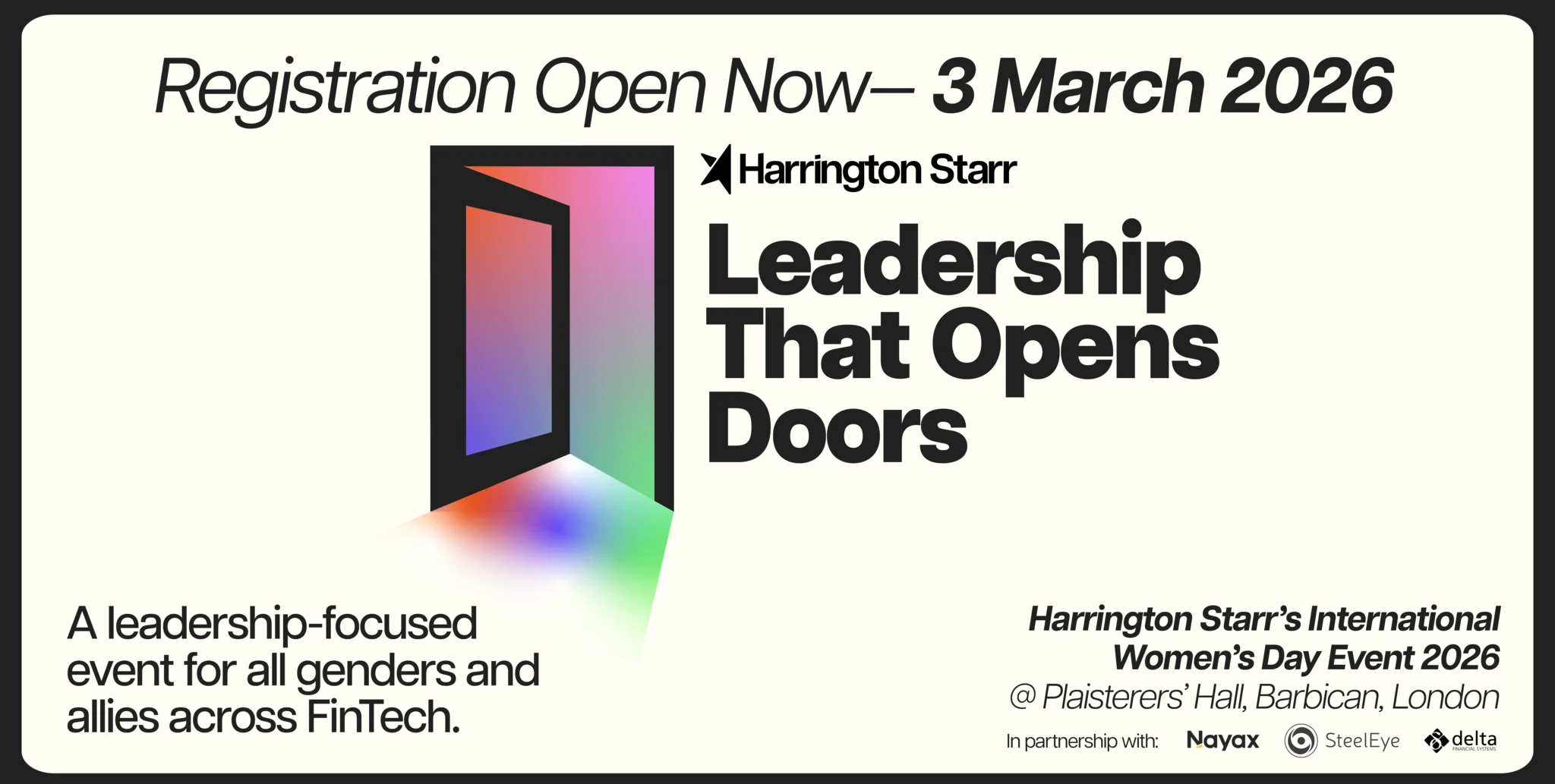
This conversation leads directly into Harrington Starr’s upcoming International Women’s Day 2026 event, Leadership That Opens Doors, taking place on 3 March 2026 at 11:00am for lunch, networking and speakers at Plaisterers’ Hall, London
The event brings together leaders from across FinTech, RegTech, Quantitative Finance, Cyber Security and Financial Services Technology. It is designed not as a symbolic gathering, but as a practical forum for decision-makers to reflect on how leadership decisions shape access and opportunity.
At Harrington Starr, we have loved organising this event, from inviting speakers to curating case studies and thinking deeply about how to network more thoughtfully. The objective is simple. We want attendees to leave with clarity on how they can open doors within their organisations and across the wider industry.
As a FinTech recruitment partner, we understand that leadership culture and hiring strategy are intertwined. The companies that open doors internally are often those that attract the strongest external talent. Reputation travels quickly in financial technology markets.
If you are a hiring manager, senior leader or emerging leader within FinTech, this is an opportunity to engage in a meaningful conversation about inclusion, growth and responsibility.
Sign up, join us in London, and be part of shaping a more equitable and innovative financial services industry.