Why You’re Hiring Wrong in FinTech
02 April, 2026

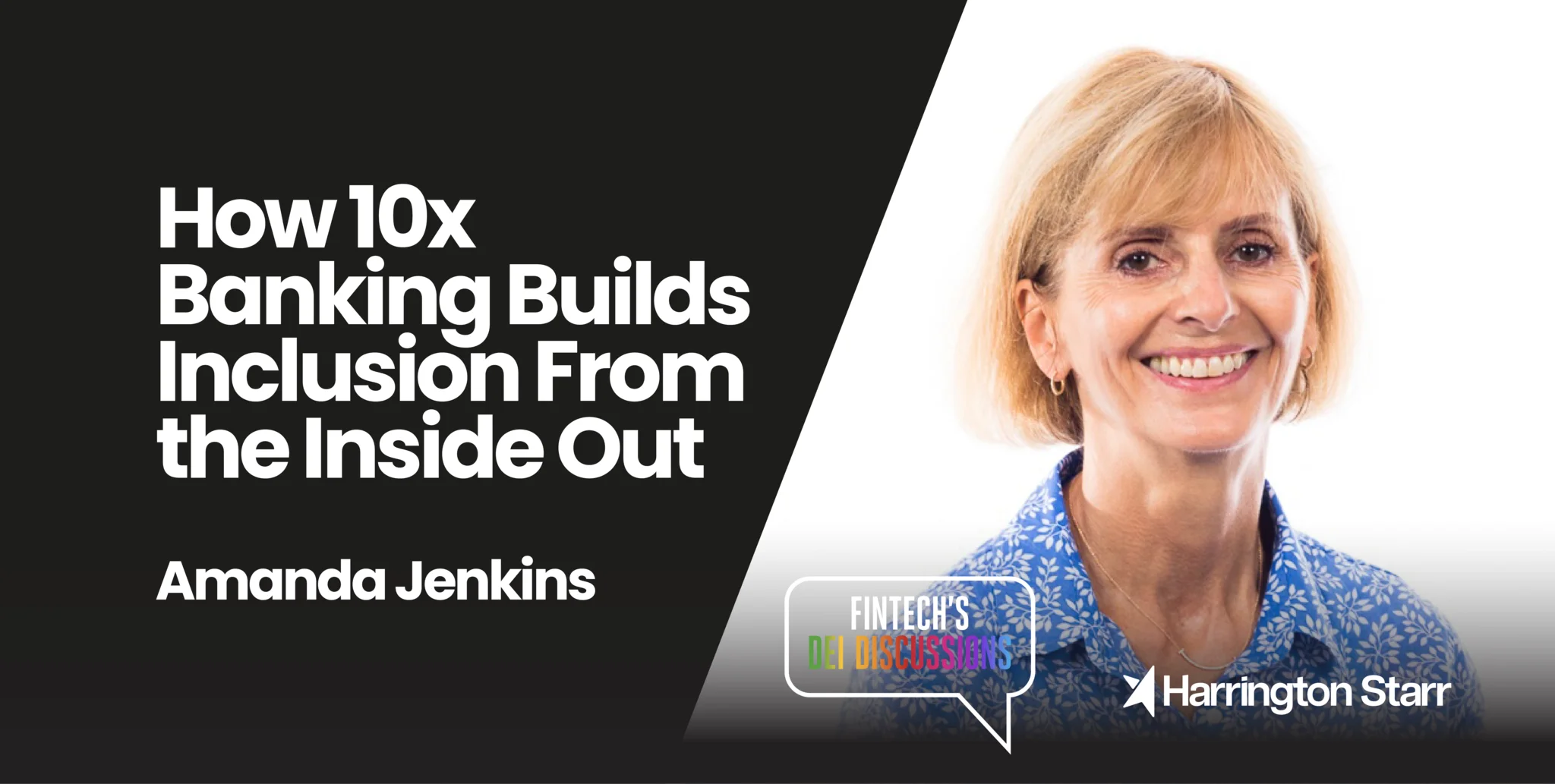
In the latest episode of FinTech’s DEI Discussions, Nadia sits down with Amanda Jenkins, Chief Impact Officer at 10x Banking, the only core banking provider decorated with B Corp Satus, to explore how inclusion, psychological safety, and values-led leadership are built into the culture of a high-growth FinTech. The conversation offers a rare and detailed look into how a cloud-native banking technology company has intentionally shaped its culture from the very beginning, and how that commitment to people, community, and impact continues to evolve. For FinTech recruitment specialists and industry leaders alike, this episode is an essential exploration of what meaningful DEI looks like in practice.
Nadia opens the discussion by inviting Amanda to share the story of her career journey, a journey that began in an unexpected place: with a degree in German and a role in the male-dominated world of Lloyd’s of London. From her early days as an insurance broker specialising in livestock, including horses, and later US liability and fine antiques, Amanda’s path didn’t initially point toward FinTech or impact leadership. However, as she reflects, there has always been a strong thread running through her story: a commitment to looking beyond her role and contributing to something bigger.
After several years in insurance and the arrival of two children, Amanda moved with her husband to New York for what would become a 13-year chapter. During that time, she continued working on the legal side of insurance but also found herself drawn increasingly toward philanthropy. She mentored and tutored young people in a local state school and became deeply involved in small charities and larger foundations, with significant time spent supporting initiatives in Dubai and Africa. These early experiences shaped her understanding of social impact, community, and the structural barriers that disadvantaged groups face, themes that now sit at the centre of her role at 10x Banking.
For those of us working in FinTech recruitment, stories like Amanda’s highlight an important truth about the sector: many senior leaders come from unconventional routes, carrying skills, empathy, and contextual awareness shaped long before they enter financial technology. These diverse journeys contribute to the richness of thought and capability that innovative FinTech businesses, and their cultures, depend upon.
The conversation turns to the founding story of 10x Banking, a cloud-native core banking platform that today powers some of the world’s largest financial institutions. Amanda explains that the company began as an idea from her husband, who had spent many years working in financial services and seen first-hand the deep technological challenges facing banks. He envisioned a technology company built to solve those problems from the ground up, and he asked Amanda to join him to shape the values, integrity, and cultural foundations of the new organisation.
The setting was humble, their dining room, and Amanda jokes that the founding team consisted of not two, but three members: herself, her husband Anthony, and their dog Johnny, who has recently turned fifteen. From these early days, they established the three core values that still underpin 10x Banking: transformation, integrity, and impact. Transformation speaks to the belief that change must be meaningfully better, at least ten times better, for people to embrace it. Integrity governs how the business operates and how decisions are made. Impact is the commitment to making the world a better place through their work.
Today, 10x Banking operates internationally, with major clients such as Chase UK, Old Mutual in Africa, and Westpac in Australia. For recruitment businesses like Harrington Starr, which work with cloud engineering, software engineering, product management, data, and technical leadership roles, 10x represents the type of tech-first, mission-driven organisation where employer brand, culture, and workplace values matter enormously to candidates. Companies like 10x rely on talent who thrive in creative, collaborative environments, and Amanda’s insights reveal why.
One of the themes that resonates strongly throughout the episode is the relationship between creativity and psychological safety. Amanda makes an important point: people outside the industry often underestimate how creative a career in technology truly is. Building cutting-edge banking software requires imaginative thinking, problem-solving, experimentation, and diverse perspectives. None of that can flourish unless people feel safe.
At 10x Banking, psychological safety is engineered into the fabric of the organisation. Amanda describes the use of anonymous Slido questions at fortnightly company meetings and at the quarterly all-team gatherings. These mechanisms give every employee a voice, regardless of seniority, background, or confidence levels. Leaders not only listen to the questions but respond to them directly and transparently, reinforcing trust across the organisation.
This continuous loop of listening, reflecting, and taking action enables the company to evolve year after year. If one were to compare the 10x of a decade ago to the 10x of today, Amanda says the transformation would be striking. For FinTech companies operating in competitive hiring markets, especially those seeking top software engineers, data professionals, and product leaders, the presence of this kind of culture is not just beneficial; it is a competitive advantage.
When Nadia asks how 10x turns values into tangible impact, Amanda outlines the company’s three pillars: community, people, and planet. Each pillar supports programs and initiatives designed to make a measurable difference both within the organisation and in the wider world.
On the environmental front, 10x established a sustainability working group made up of volunteers from across the business, including senior leaders. They began with simple initiatives such as recycling and have now progressed to measuring their environmental data for three consecutive years. They examine travel, office energy consumption, and even consider carbon footprint when selecting new office spaces.
One of the most powerful community programmes is the Future of Tech initiative, which invites young people from less advantaged backgrounds into the company for a week of work experience each summer. Unlike typical shadowing, these students spend an hour with every team, legal, procurement, HR, impact, and of course the engineering teams, so they can see how a business truly operates. This level of exposure helps demystify the FinTech industry and encourages greater social mobility by giving young people confidence, insights, and opportunities they might not otherwise access.
For FinTech recruitment companies like Harrington Starr, these programs resonate with a fundamental belief: diverse talent pipelines do not emerge accidentally. They are built through intentional outreach, inclusive hiring practices, and sustained investment in underrepresented groups. Amanda’s work at 10x aligns precisely with the types of inclusive hiring strategies that help FinTech businesses compete globally for talent.
In discussing internal culture, Amanda emphasises that employees at 10x are encouraged to voice what they need from the business. Any employee can create a network, and existing groups include the Neurodiversity Network and 10x Women and Friends. These networks are not symbolic; they are active communities that drive real change within the organisation.
Survey feedback from women in the business revealed areas where the organisation could strengthen its support, such as maternity policies, menopause support, and other programmes addressing challenges women face in technology. In response, 10x made meaningful improvements. Flexibility is another pillar of the employee experience, valued especially by parents and caregivers who benefit from the company’s adaptable working approach.
Amanda describes the level of openness and responsiveness as core to how 10x operates. Whether improving policies, creating new initiatives, or designing events, the business constantly asks: what do our people need, and how do we support them? For jobseekers evaluating FinTech workplaces, especially women in technology, individuals from underrepresented backgrounds, and those who value psychological safety, employers like 10x stand out because they design culture around lived experiences rather than assumptions.
Another important focus of the episode is wellbeing. Amanda explains that as soon as the company was financially able, they introduced medical insurance for all employees, recognising the importance of both physical and mental health. The Employee Assistance Program gives staff access to professional support whenever they need it, and managers are trained to handle wellbeing concerns effectively.
The company supplements this with an impressive range of wellbeing activities. Their HR Director, who is also a trained nutritionist, runs regular sessions. A member of the team is qualifying as a Pilates instructor. They have previously offered yoga classes, sessions with a sleep specialist, wellbeing days, running clubs, Strava challenges, and more. Amanda’s philosophy is simple: if someone suggests an idea that benefits the team, the business is open to trying it.
These holistic wellbeing practices align closely with what we at Harrington Starr, as a FinTech recruitment partner, hear consistently from candidates. Today’s FinTech professionals, engineers, data specialists, product managers, cybersecurity experts, and business leaders want more from their employers than competitive salaries. They seek workplaces that support their health, flexibility, professional growth, and sense of belonging. Employers who embed wellbeing into their cultural identity attract stronger talent and retain it.
Amanda also highlights how physical space contributes to workplace culture. The company’s new office features a large communal area designed to bring people together. Employees regularly gather for coffee, lunch, or informal conversations, and the space is equipped with computer games, Lego sets, and a pool table. These elements might seem small on the surface, but they foster connection, creativity, and collaboration, essential ingredients for successful technology teams.
Recently, 10x hosted a public speaking workshop led by a professional coach. This initiative stemmed from survey feedback indicating that many women found public speaking challenging. The session, delivered through the Women and Friends network, attracted both women and allies, and created what Amanda describes as “a real buzz” throughout the day. Activities like this reinforce the idea that inclusion is not simply a value at 10x; it is a practice.
Toward the end of the episode, Nadia asks Amanda what advice she would give to organisations eager to strengthen their approach to inclusion. Amanda’s guidance is simple but profound: start small. She shares the story of an early initiative at 10x when the company had only 35 employees. Through a personal contact, they partnered with a school in Haringey, and eight employees would visit every couple of weeks to speak with a group of year ten students. This mentoring relationship grew into a broader connection, including office visits and evolving community programmes.
Over time, 10x broadened these outreach efforts, establishing new partnerships, running career days, and developing graduate-focused initiatives such as CV workshops and interview support. They recently ran a session for second- and final-year students at Manchester Metropolitan University, offering career guidance from senior leaders. Such activities reflect a deep commitment to social mobility and to shaping future pathways into the FinTech industry.
Amanda’s final message is that not every initiative will succeed, but organisations must be willing to experiment, learn, and adapt. When something works, build on it. When it doesn’t, reflect and evolve. This mindset mirrors the iterative nature of technology itself: test, improve, and grow.
This episode of FinTech’s DEI Discussions offers more than a look inside one company. It highlights what the next generation of FinTech workplaces must become if they want to attract, develop, and retain world-class talent. Inclusion, wellbeing, psychological safety, values-led leadership, and community impact are no longer optional. They are fundamental to innovation, competitiveness, and long-term success.
For Harrington Starr, as a FinTech recruitment business working across London, New York, and global markets, these insights underline what candidates consistently tell us: the best FinTech companies are those that put people first. The organisations that thrive are those that understand culture as a strategic asset, not just a buzzword.
Amanda Jenkins’ story shows exactly how this philosophy can be brought to life, and how inclusive leadership shapes not just workplace culture, but the entire FinTech ecosystem.
If your FinTech business is scaling, hiring, or evolving its culture, conversations like this one offer invaluable guidance. And for candidates seeking meaningful, innovative roles in the sector, 10x Banking’s approach reflects the type of environment where talent can truly thrive.